Garden Hoses
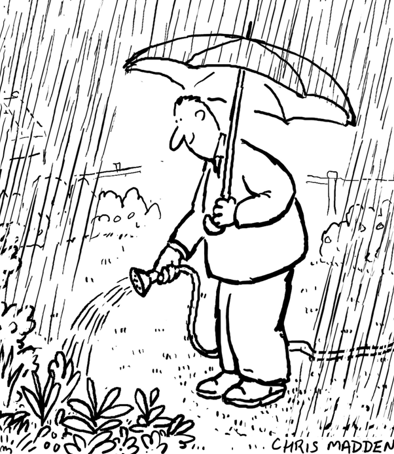
Credit: Chris Madden/Cartoonstock
There is really no reason for anybody in my entire housing estate to own a garden hose. That might seem a blasphemous comment for an Australian to utter as it is highly likely that this country’s famed and ferocious bushfires will, on running out of actual bush to ignite, come after the ever-growing suburbs, but it is true. Some of the homeowners in my area may think it sensible to buy a water-propelling device that they can use to defend themselves against the ever-growing, climate change-related fire season, but the only really sensible thing to do when a wall of flames is headed in your direction is to swiftly vacate the area.
That said, if people want to be in possession of a long hose for safety reasons (or at least the illusion of safety reasons), that is perfectly fine. What nobody should be purchasing from Bunnings is a fifteen-metre hose with a high-pressure nozzle to help them maintain their small concrete patio’s ornamental potted garden.
That statement probably seems quite silly. Anybody reading this with any sort of common sense must now be wondering why I am dispensing consumer advice that couldn’t possibly be needed. Surely nobody is jet spraying their pot plants, right?
Well, no, not yet, but based on the outrageous watering habits of the hose owners in my neighbourhood, we are certainly headed in that direction. While exercising around my local area in the last few months, I have had the misfortune of witnessing the following hose-related atrocities:
Someone washing their car with their garden hose in the middle of a torrential downpour.
Someone spraying water haphazardly in the general direction of their greenery while standing on the porch looking at their phone.
Automatic sprinklers coming on in the early hours of the morning when it has rained the entire night.
A high-pressure nozzle being used used on a one-by-two metre patch of grass.
The brazen hosing down of two concrete driveways; and
A hose that had been turned on then left to manage the dispensing of water itself while its owner was inside the house (and judging by the lake that was once a flower bed, said hose had been working unsupervised for quite some time).
I really shouldn’t need to write a blog post to explain the appropriate use of a garden hose to suburban garden hose owners, but the residents of my neighbourhood have demonstrated that this blog post is essential.
Now, I know that some readers are already mentally drafting the long email they are going to send me about how water usage on suburban blocks pales in comparison to that used by the agricultural sector, so I better say up front that they really needn’t bother. Even if the email is very well written with minimal spelling mistakes, links to various reputable sources, and without any telling signs of having been written by a chatbot, it will still be immediately filed into the folder reserved for people that have missed the point of this blog.
This site is about pointing out the value of taking some personal responsibility for the perilous environmental predicament humans have gotten ourselves into. The agricultural industry doesn’t exist as an abstract entity, nor do the tech, mining, transport, manufacturing, or other mass polluting sectors. They exist because each of us, individually, chooses to use their services. I certainly do—it is practically impossible to function as a human and avoid them all completely—but I am getting better and better at using them less, and am mentally, physically, financially, and ethically, all the better for it.
Those that limit their consumption to the necessities might appear to be submitting themselves to an unpleasant pauper’s life of sacrifice, effort and discomfort, but the quiet truth is that a simple, kind and humble life is actually a deeply happy one. Making the decision to live a life that causes as little environmental harm as possible is freeing, and it only takes the removal of a little consumerist clutter to feel the neo-capitalist shackles start to loosen.
That said, getting started can be tough. Our brains tend to urge us away from the physically and mentally arduous options, and toward the most pleasurable options, which are rarely the best for the planet. The thought of giving up Amazon shopping, bi-yearly interstate flights, air-conditioning, beef burgers, and the five-minute car trips to walkable distance shops will likely feel too laborious and painful for anyone well-immersed in our effort-free culture, but that’s no reason to just throw up one’s hands, announce that the planet is stuffed, and put a deposit down on a diesel-fuelled SUV. Just start with something small. Something that won’t impact pleasure-saturated lifestyles, wardrobes or taste buds. I.e., the outside tap.
Limiting one’s water usage to only what one really needs is sensible regardless of where you live, but doing so in Australia is imperative. While it might seem that tap water is endless, our landmass is only going to get dryer over the next few decades as the average temperature rises, more forests are felled, farmlands are expanded, and the population (of both humans and their herds of dejected dinners) steadily increases.
For this reason, it is important to consider ongoing water requirements when planning our outdoor suburban spaces. A lawn might be a perfectly reasonable option if you are short on gardening time and have plenty of rain, not so much if you are living in a desert. Maintaining a lush green lawn all the way through your city’s dry season may feel impressive, but you are really just demonstrating to the neighbours that you know how to operate an automated sprinkler system and that you care more about your dog having a five-star toilet than the water needs of everybody else.*
If everyone turned their little square of yard into a haven for local wildlife, with plants that suit the natural rainfall cycle of the location, that would certainly be space well used, but if my suburb is representative of suburbs in general, that is not the norm.
Actually, to use the word ‘garden’ at all in my area might be a bit of a stretch.
My housing estate sits on the very edge of what you would call the suburbs. It grasps tenuously at being included in what you would call the city. The houses are packed tightly together, and there are almost as many fast-food restaurants as residents, yet we don’t have to walk far to hit fields. (At least, we didn’t a year or two ago — property developers are working doggedly to replace our pleasant jaunts through the countryside with ever more houses and takeaway joints.)
It is one of those estates where many of the houses are attached to each other and the “garden” consists of a narrow slab of concrete between the building and the front or rear fence. The best we can hope for, in terms of a yard, are some pot plants or a couple of planter boxes crowded into the single corner of the patio that the sun manages to reach. Most of my neighbours have accepted that a two-by-four metre patio is no place to start a horticultural business nor a prize-winning rose garden and that, as disappointing as it may be to not have an enviable patch of greenery out front, it is probably better this way.
For starters, it is much easier to manage busy online lives when there are only three pot plants to water. It is also not so destructive to the self-esteem when people realise their busy online lives distracted them from the task of pot plant watering and their little corner of greenery is now just a collection of dead sticks. Not great for the pot plants, obviously, but if their sacrifice discouraged townhouse suburbanites from relocating to a property with an established front garden to neglect then pave over, they died a worthy death.
More importantly, it is better for the planet if we all live small. The more closely-knit we humans live, the less wilderness we raze for sprawling housing estates, and while the end goal of most Australians seems to be an oversized house and a manicured lawn, it would really be better for everyone, long-term, if we all tried to live in smaller, more compact homes and returned as much of the Australian wilderness to the way it was before we chopped all the trees down, turned the landscape into paddocks, then covered it all with concrete.
Some readers may be feeling annoyed that I would suggest a tiny concrete patio arrangement is environmentally preferable to a lovely, spacious garden, but those people probably haven’t spent a lot of time walking around the suburbs. Having lived in many of them, I can attest that most people don’t use their outdoor space as a wild haven for native plants and animals, nor even as a food producing space for the resident humans or insects. They are more commonly used for the artful laying of pebbles, woodchips and concrete, as an excuse to buy a second dining suite, and for water-intensive (or plastic) lawns.
To have a front or back yard is a gift, and we should think of it as our most important room - even during the winter when everyone would prefer to stay in the one that has heating, a sofa and a wide-screen television. It is not just there to impress the neighbours or as something pleasant to look at out the window while the next TV show is loading. It is a lifeline to the world that was there before; to the few local bird and insect species that have managed to hang on and survive, despite the catastrophic annexation and unwanted refurbishment of their perfectly lovely neighbourhood.
It is also the only way we can bring life into our homes without having to deal with childcare fees, kitty litter or extra washing up. Plants can be a little temperamental, but they will never wake up in a mood, destroy your furniture, or leave dirty dishes in the sink. What they will do is demonstrate the value of living slowly, intentionally, and with care. They don’t ask for much and will do most of the work of slowly growing into something beautiful on their own, but they do need a little of our time and attention if we want them to actually survive. We need to think about their needs in terms of space, light, soil and, most importantly, water. It is possible for most suburbanites to water their whole garden from the porch, with a hose, while scrolling, but doing it that way means missing out on the joy of being present and engaging with the plants. It also means they are likely wasting water.
For the benefit of plant life, the nation’s water resources, and human happiness, people are best off investing in a watering can. They may be more time consuming to fill, heavier to lift, and bulky to use, but that is why they are good. Once a can operator has figured out the specific water needs of their garden, they are much less likely to waste water by overfilling it as no sensible person would want to carry a watering can that is heavier than it has to be. Carrying one from plant to plant also means getting an excellent arm workout and the pleasantly proud feeling of having completed something slow, tedious and hard. Most importantly, the plants will appreciate their sustenance coming in the form of a light shower (accompanied by some friendly chit-chat if there are no neighbours peering over the fence) rather than via a quick and violent drenching from someone hurrying to to get back inside the house.
The Quiet EnvironmentalistFurther information
Watering by Hand | Regional Water Providers Consortium
Water Corporation, Western Australia | Using water outdoors do's and dont's
When To Use A Watering Can: Tips On Using Watering Cans In Gardens | Gardening Know How
How to water your plants | BBC Gardeners World Magazine
Water Account, Australia, 2021-22 financial year | Australian Bureau of Statistics
State of the Environment SA 2018
Earth is trapping much more heat than climate models forecast – and the rate has doubled in 20 years
* Failing to turn off your automated sprinkler during the wet season will only exacerbate your neighbours’ ire.
Published 4 January 2026