AI
Credit: Sunil Agarwal/Cartoonstock
I am, at the time of writing this, one of a dwindling number of internet users that have never intentionally used AI. I say intentionally as I have no doubt it has polluted the background of almost every web page I frequent, but not in any way that I can tell. That is, nothing about how I use those sites has changed since the (good old) pre-AI days, and I’ve certainly never sought out a bot for help. Fortunately, most web pages proudly announce where they’ve inserted their brand new, unsolicited AI, which makes it really rather easy to avoid.
I don’t think I’ve even been exposed to it – at least, not in the way most people are. I’ve read about how life in the digital world now requires one to wade waist-deep through a noxious vat of AI slop, but I don’t see ads or watch Youtube, I have no social media accounts, I’ve never listened to an algorythm’s playlist, and I haven’t changed what I do online since the AI takeover began. (If anything, I now use the internet much less.)
I do feel it encroaching. Many sites have added AI buttons that one can press to reduce the effort of having to be on their site (none of which I have pressed), some have kindly given me the option of adding their AI features (all of which I have declined), and a few have even added friendly chatbots for me to talk to (every one of which I have ignored). Having managed through the last few years ̶ ̶ and quite a few decades before that ̶ ̶ without needing artificial intelligence, I’m quietly confident I can get through the rest of my life without using it.
At this point, you are likely wondering what business I have writing a very long blog post about something that I have not used, nor intend to, but the fact that I have never felt the pressing need to seek out the opinion of a chatbot really supports the entire point of this post. The point being that AI, for most of us, is entirely unnecessary.
As this is an environmental blog, I imagine most readers will assume I am taking a strong anti-AI stance because of how damaging it is to the climate, but that isn’t exactly true. My response to learning how much water and energy AI would need was, naturally, anguish, rage and horror, but that only added concrete to my well-cemented stance. AI will certainly blow out humanity’s already unacceptably large digital carbon footprint, but even before I realised that very painful truth, I knew it would be unethical to use it.
AI was trained on millions and millions of human-made stolen sentences. Sentences that people would have put considerable effort into thinking of, writing down and editing together into something that sounded quite good. To use AI would make me complicit in that horrifically brazen theft, and I’ll take no part in something so appauling. I love sentences. Specifically the ones people turn into wonderfully well-worded books. I know how much effort it takes to write a book (much more than this grumbling blog), and it is odious to think that all that work is now being used to create plagiarising, unnecessary bots.
And they are almost entirely unnecessary. Do we really need everything to run more efficiently? Do we really need to create any more stuff? Don’t we already have too many sentences to read in this attention-depleted, reading-wary world? And is it really a good thing that companies can now prosper without humans doing much (or any) of the work?
I know some will argue AI is essential for their complex and indispensable role, but, for most people, AI isn’t about catching wildlife smugglers or putting out bushfires before they start ̶ ̶ it is just a way to do time-consuming and tedious tasks without putting in a great deal of work. (Or as a replacement for humans who would like to keep doing all that underpaid, tedious work.) I’m sure there are a number of circumstances where it is imperative to use AI, but in every example I’ve ever been given, the same thought has come to mind: That person could have completed that task more than adequately well if they’d only troubled to put in the effort of doing the work, themselves.
In fairness, sometimes it would have taken many humans a good deal of effort and time, and AI might still have completed that task much better, but the absence of human thinking devalues whatever AI creates because anyone who opts to use has taken a shortcut.
I do appreciate that AI is impressive, from a technical point of view. Anyone with a hand in inventing it has done exceptionally. They certainly deserve their accolades, but that’s as far as we can go, as nothing that makes use of it should be celebrated. AI is the intellectual equivalent of a performance enhancing drug, which we don’t allow in sport because that is cheating. Why should we consider it any different for those whose professions involve thinking, writing, research, and creativity?
That AI can now be used to write articles, academic papers, resumes, essays, assignments, reports, etc. is a tragedy, nothing less. Rather than the great global equaliser that people imagine it to be, it will just ensure that the unscrupulous get ahead.
And, of course, it is not just the nefarious that are now using AI. It is also being adopted by our youth. Young people today may be the most tech savvy and well informed in history, but they are as homework allergic, peer conforming, and long-term risk apathetic as the children that came before them, which makes them the ideal consumers of AI.
If most young people can now get to adulthood without writing essays, solving equations, decyphering complex ideas, learning foreign languages, or even having to read an entire book, how many will persevere through the pain of practicing those skills until they can competently (even pleasurably) complete them? Very few, I imagine. Certainly none with commonsense. Why waste time and energy on a difficult homework task when AI can provide the answer and phrase it better?
Unfortunately, every technology of convenience has to come at a cost, and the cost of using AI will be one’s cognition. We know what happens, long term, when we replace movement with technology: our bodies go on expanding and lose their function. This may not (yet) be evident among our e-biking / e-scootering youth, but examples abound among their SUV-driving parents. Now that young people can also outsource their thinking to AI, the future middle-aged won’t just be enormous. If young people don’t develop the habit of making their brains do challenging work, they’ll eventually struggle with things that we find easy. For example, drafting a personalised response to a client is a task that will seem overwhelming; writing a heartfelt message in a birthday card will be terrifying.
Any time people use AI for something that seems a bit laborious, they are missing out on giving their brains a workout. Outsourcing seemingly unimportant tasks might not seem too problematic, but it all adds up to how well people think. The less a brain is challenged, the harder thinking gets, until anything cognitively difficult becomes overwhelming. AI use won’t just result in written grammar getting worse, it will mean a dearth of ideas, creativity, and witty humans.
Personally, I’d prefer not to eventually become a dull, befuddled octogenerian; I’d rather spend that decade doing activities. I’ll have books to read, puzzles to complete, and languages I’ll want to study (not to mention plenty more grumbly sentences to write). Therefore, I’m not going to risk debilitating my currently-well-functioning brain by outsourcing all its exercise tasks to AI. We’re not going to know for decades if AI increases one’s dementia risk, but if does, no one sensible will be surprised. Our brains only continue to function if we regularly put them to use, so I’d much rather work on that then get things done quickly.
I’m lucky, it is true, that I don’t have any micro-managing superiors, although my employers do encourage us all to use AI. When they suggest that staff employ it for tasks we’ve always done ourselves, I just quietly carry on doing them, and nobody notices. I appreciate others may not be able to if their KPIs have shot through the roof, or if they have an always hovering, efficiency-obsessed director, but I recommend it for anyone who is managing their tasks themselves, and whose morale at work would benefit from some silent resistance.
Like most people who spend their days just staring at a computer, I assume AI will, sooner or later, take my job. I am, therefore, quite determined to use the limited time I have left to get in as many cognitive workouts each day as possible. I compose my own emails, do my own research, and write my reports, myself. Instead of just copying and pasting data in, I exercise my memory. It may seem like I am wasting time on pointless drudgery, but as I’m practiced at it, I’m efficient and do tasks properly.
Completing my work manually gives me a greater sense of accomplishment than I could ever get if I handballed tasks to AI. Lots of little daily achievements lead to a happier working life (yes, it’s possible to make one’s humdrum job feel satisfying). My output may take a little longer than that of my AI-savvy colleagues, but I’m still a well-appreciated worker. I’ve never submitted a report containing empty AI jargin, or anything a chatbot’s brazenly made up. And as doing things myself makes me feel proud of what I’ve achieved, I’m a happier, more dedicated employee. Maybe future bosses will only want people that can write good prompts, but I hope some will still want those that write whole paragraphs. We’re more likely to be satisfied (with our work and with ourselves), which means we’ll end up causing those bosses a lot less bother.
The carbon cost should be enough to stop people wantonly using AI, but I appreciate that many workers have no option. Those being forced to train the chatbots that will take over their desperately needed jobs have nothing but my deepest, humblest sympathies. Outside of terrible workplaces, at least, there are alternatives we can use, and they’ll generally give us more interesting results. For example, books, search engines, other humans, and our brains served us well enough until AI (regretably) arrived. They may not always immediately provide us with confident, well-worded answers, but when we’re forced to consider different viewpoints, we tend to get wiser.
Some might view any AI alternatives as quaint and inefficient, but with just a pencil, some paper, and a little quiet pondering, many people have accomplished great things. We may not be able to word our thoughts quite as well as Virginia Woolfe, but very few of our intended readers will mind. Certainly, friends and family would rather read our grammatically avant-garde emails then a generic, well-worded message from a chatbot. Those that must write professionally (such as for teachers, employers or audiences) should view all writing tasks as opportunities to practice.
I’ll concede that there are situations where AI really is unavoidable. For example, cyber law inforcement units will need to use it. That is the only way they’ll compete against the legions of unscrupulous people now using AI to scam the vulnerable online. It should also be rapidly engaged to replace the millions of wretched animals being tortured inside science labs around the world. If it were solely used for those two things, I would be enthusiastically on board, but as it is mostly being employed to save brain energy, I am not.
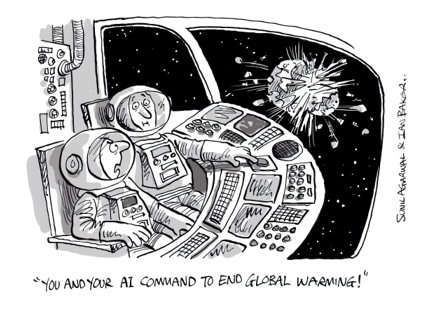
The coup de grâce was, naturally, its horrendous carbon footprint, yet if it only ran on solar, I still wouldn’t use it. AI is going to speed up humanity’s planetary destruction, despite what many Silicon Valley CEOs will tell you. Some people (mostly greedy tech bros and billionaires with private planes) claim it will figure out an answer to the climate problem, but as the most sensible solution would be to simply wipe our species out, let’s hope AI’s not too dedicated to the problem. Any other ideas it comes up with will be more than swallowed up by the assistance given to companies that profit from fossil fuels. And while it may be sometimes used to nudge people towards environmentally friendly choices, it will spend more time helping consumers buy new stuff.
In the future, I may be forced to use it if I want to remain in any job, and I know it’s already in the background of everyday life. Therefore, some may see it as futile to attempt to live a life that’s AI-free, but I’m determined to get through the rest of mine without ever using it.
That goal feels like it’s, surprisingly, getting easier to achieve, as my disdain for AI is moving me more offline. The appearance of AI everywhere has made the internet lose its appeal, and I’m rediscovering the joy of the low-tech world. In fact, the less I’m on the internet, the happier I become (it’s burdensome connecting to everyone all the time). I know that seems contradictory for someone with two online blogs to say, but I’m not contributing to the burden if nobody’s reading them. (They’re not.)
Nowadays, my time online consists of an hour or two on a Sunday, mostly to delete my emails and catch up on the news.* At night I write on a laptop that’s not connected to WiFi, using the version of Word that doesn’t contain AI. Other than that I spend my free time doing all sorts of pleasant things, none of which require internet, chargers or screens. (Mostly walking, gardening, pondering, doing things around the house, spending time with animals, and reading nice old books.) I have very little engagement with the AI-entrenched digital world, and, for that, my wellbeing, conscience, and mind are grateful.
The Quiet Environmentalist
Further reading:
AI Agents Are Taking America by Storm
AI Is Killing Artists’ First Jobs - The Atlantic
Australia is facing an ‘AI divide’, new national survey shows
Climate: A.I.’s insatiable appetite for energy
Data centres are guzzling up too much electricity. Can we make them more efficient?
Google and Microsoft report growing emissions as they double-down on AI : NPR
Inside the Dirty, Dystopian World of AI Data Centres
It Makes Sense That People See A.I. as God - The New York Times
Opinion | How A.I. Could Make Us Dumber - The New York Times
Science Is Drowning in AI Slop - The Atlantic
The Hidden Environmental Impact of AI
The Worst-case Future for White-collar Workers
Is AI the greatest art heist in history?
Researchers Say AI is Homogenizing Human Expression and Thought
* I am online during work hours, but only for work-related stuff and, begrudgingly, for <laugh-face> emojing carbon-wasting GIFs on my team’s chat. (Nb. The storage of pointless digital crap is such a horrifying environmental problem that it is going to require a whole other outraged post.)
Published 7 June 2026